


ACROPOLIS – FORTRESS Stronghold of a blue state
From the upper level of the central circular tower, a wonderful view over the whole of the town of Kavala can be enjoyed.
Related Posts
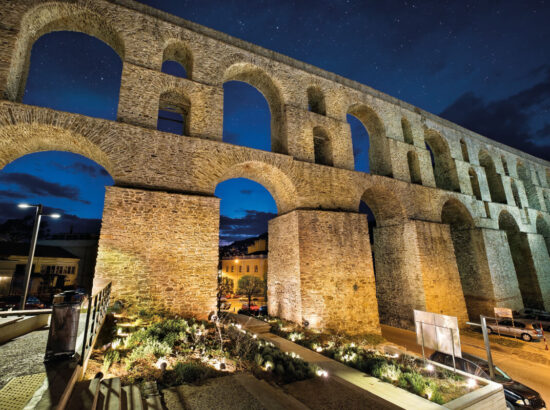
Kamares – Aqueduct
The most characteristic monument of Kavala is the large, arched aqueduct, known by the name “Kamares” (Arches), with a length of 270 m and a maximum height of 25 m. In the early 16th century, the arid peninsula of Panagia found a water supply in the streams that ran from the area of Old Kavala. The source of this water, which is located at an altitude of 400 m, is known as “the mother of the water”, “Soubasi” or the “three Karagatsia”. The Kamares in their present form date to the early 16th century and are attributed to Ibrahim Pasha, the vezir of Sultan Suleiman the Magnificent. They were built in 1520-1530, a period during which many infrastructure works were carried out in Kavala, with the aim of reconstructing the city after the destruction of 1391. The Kamares are a huge structure, out of proportion to the size of the then insignificant settlement. It is believed that there had been a Roman aqueduct on this same spot, over the ruins of which the Kamares were built. This old aqueduct supplied water to the town of Kavala through the region of Suyol (su-yol: “waterway”) until the early decades of the 20th century. The Kamares are no longer of vital importance, but they maintain their beauty and grandeur and are a landmark of the town.

City Hall
The building in which the Municipality of Kavala is housed today is one of the most impressive buildings in the whole town, with a unique architectural style that appears “foreign” within the environment of Kavala and is reminiscent of a miniature Hungarian tower. Its construction is dated to the late 1890s. It belonged to the Hungarian tobacco merchant Baron Pierre Herzog and was used as both a residence and a place of business. It has the deeply romantic features of medieval castles, such as Gothic arches on the towers and balconies, two Venetian Gothic apses on either side of the gate, a dripstone over the window and an oriel window, and is a shining example of the Gothic revival. The building was purchased by the Municipality of Kavala in 1937 and has, since then and until today, housed the office of the Mayor and some of the Mayor’s administrative services.


